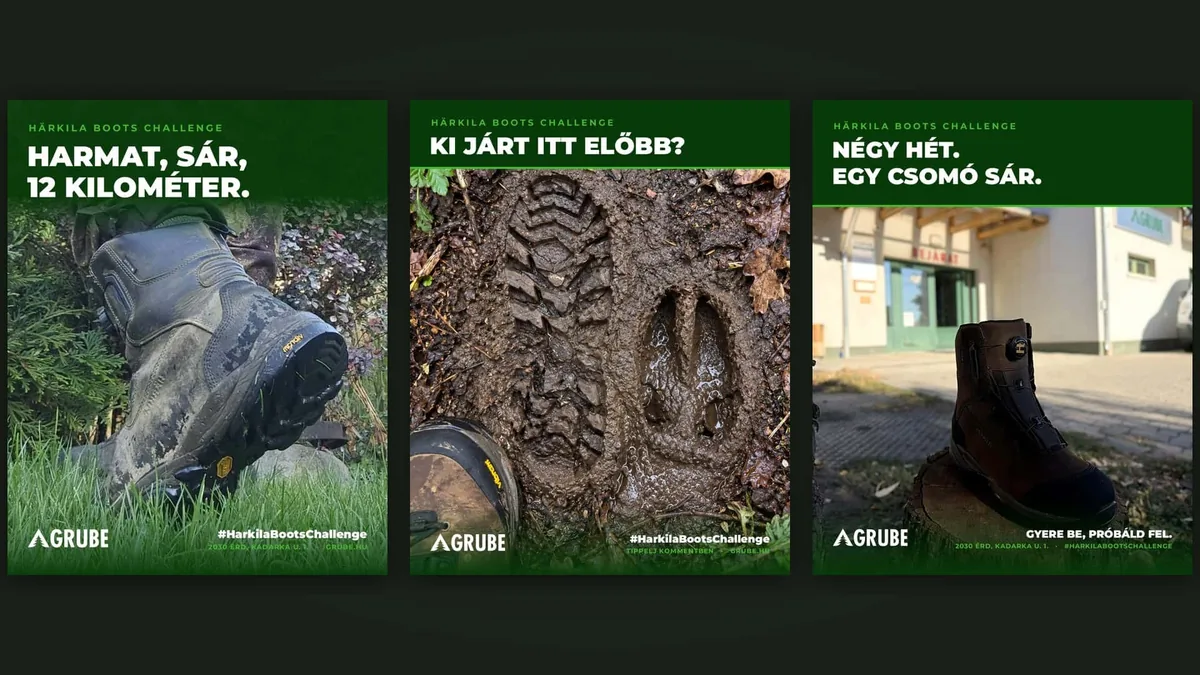
A manufacturer’s competition brief is not a campaign in itself. This case study shows how we turned the four-week Härkila Boots Challenge partner competition into a complete, measurable social media campaign for Grube Kereskedelmi Kft. – with eight posts, original photos and verified product data.
Starting point
Grube Kereskedelmi Kft. is a specialist retailer of forestry, hunting and outdoor equipment: it runs a physical specialist shop in Érd, Hungary, as well as an online store (grube.hu). Its range includes several hundred brands, among them the Danish hunting apparel brand Härkila.
In September 2026, Härkila announced the Härkila Boots Challenge campaign to its retail partners. The brief was simple: for four weeks, at least one piece of content per week featuring the brand’s footwear, on Instagram, Facebook or TikTok, with every post tagging @harkila_official and using the #HarkilaBootsChallenge hashtag. Each week also had a theme: presenting your favourite model, the boots in use, a free creative theme and, finally, the question “why Härkila?”. The jury scored entries on three criteria: 45% content performance, 35% creativity and quality, 20% audience interaction.
The client was not motivated by the prize. The value of taking part lay elsewhere: demonstrating partner activity to the manufacturer and, for its own audience, a content hook around which communication could be built for four weeks. Two circumstances tightened the scope, however: there were only a few days left for planning, and at that point the client had no ongoing, regular social content production.
The task
We had to produce a complete content calendar and the related creatives for the four weeks of the campaign, for Facebook and Instagram, using static image posts. The goals:
- meeting the formal requirements of the competition brief flawlessly in every single post;
- a more frequent presence than the mandatory one post per week, because 45% of the score depended on content performance;
- presenting the Härkila footwear range with real, verified product data;
- linking the brand with the shop in Érd as an element of trust;
- platform compliance: presenting hunting content without breaching Meta’s advertising and content policies.
How did we approach it?
1. We broke the brief and the rules down into mandatory elements. The competition rules gave us three conditions that every post had to meet: visible Härkila footwear in the image, a tag of the official profile and the campaign hashtag. We built these three into the calendar as checkpoints, so that no piece of content would be disqualified for a formal error.
2. We checked the actual product range. Instead of working from the manufacturer’s catalogue, we went through the Härkila range on grube.hu. We identified six footwear models that were actually available, together with model name, price, size range and stock status. This way, every technical claim in the post copy – GORE-TEX membrane, Vibram sole, lacing system – came from the online store’s own product descriptions, not from assumptions.
3. We tracked down the official brand guidelines. In the client’s Drive folder we found a corporate identity manual that had not been used until then. It provided the entire visual basis for the creatives: the three brand colours with exact hex codes, the web typography and the rules for logo use. This also settled a question in the client’s communication that had been open until then.
4. Instead of the minimum, we planned two posts a week. The rules required one piece of content per week, which is enough to take part but too little to perform well. We planned one mandatory themed post and one supplementary post each week: eight in total over four weeks, alternating between weekday evening and weekend morning scheduling.
What did we produce?
- An eight-post content calendar in Google Sheets, with 23 data fields per post: scheduling, campaign goal, target audience, problem solved, unique value proposition, tone of voice, CTA style, full post copy, hashtags, linked page, creative brief and technical specification.
- Eight static creatives for Facebook and Instagram, in 1080×1080 and 1080×1350 sizes, with a consistent visual identity.
- A photo list for the shop: descriptions of eight specific photo sets with deadlines, so that the shop team knew what to photograph – with a phone camera, as the brief explicitly said that a perfect production was not required.
- A risk and to-do list at the bottom of the calendar: formal compliance, platform policy, out-of-stock model, results tracking.
What problems did we solve?
The risk of invented product features. In a competition judged by the manufacturer itself, and where much of the audience is professional – hunters and foresters – an incorrect technical claim or a wrong model name gets spotted immediately. That is why every product feature in the copy came from the online store’s own descriptions, and where the specific model in a photo could not be clearly identified, we did not name a product.
The platform policy risk. Hunting is a sensitive category at Meta. We built into the creative briefs that weapons, ammunition and harvested game must not appear in the images – instead, we conveyed the hunting context through landscape, terrain and equipment.
The lack of visual material. No images were available when the campaign started. We built the first creatives from the online store’s own product photos and, in parallel, handed the list of requirements over to the shop. From the second week onwards, the creatives were based on the shop’s own photos taken in the field – these provided the strongest images of the campaign.
The result
All eight posts were published on schedule, on both Facebook and Instagram, throughout the entire competition. Performance of the campaign posts between 7 September and 7 October 2026:
- 18,455 impressions (Facebook 13,935, Instagram 4,520)
- 12,391 people reached (Facebook 9,726, Instagram 2,665)
- 86 interactions (reactions and comments)
- 484 clicks on the posts, of which 59 were click-throughs to the online store
The highest reach came from the social proof post: a new boot and one that had been through three seasons side by side, with a genuine customer review from the online store – 3,053 impressions on Facebook. The best engagement rate, however, was achieved by the creative, question-based post: a boot print and an animal track side by side on muddy ground, with the caption “Who was here first?”. This post achieved an engagement rate of 10.61, brought 70% of the campaign’s comments and also the most clicks (183).
The context of these numbers matters: this is organic presence with an existing, not particularly active audience, using content without any paid support, over four weeks. As a side benefit of the campaign, the client’s Instagram account was also activated: until then, its website had not featured a single social media link.
What did we learn from this campaign?
- Proof spreads further than argument. The highest reach did not come from the post listing product features, but from the one that showed what the same boot looks like after three seasons.
- Questions bring comments. Out of eight posts, a single guessing-game post accounted for 70% of the campaign’s comments. Where 20% of the score depends on interaction, this is no small matter.
- Your own photos beat catalogue images. The first two posts were built from product photos, the rest from the shop’s own field and in-store images. The latter performed better.
- Verification does not slow the campaign down; it protects it. At several points it turned out that a seemingly obvious claim could not be substantiated – we preferred to leave these out rather than be caught out in front of a professional audience.
Summary
A manufacturer’s competition brief is a free content hook, but not a campaign in itself. The value comes when the mandatory elements of the brief, the client’s real product range and its own visual identity come together into a content arc that the audience finds interesting too – not just the jury.
For Grube Kft., this meant eight posts in four weeks, more than 12,000 people reached and the activation of a previously unused Instagram account – all without any ad spend. Alongside the campaign, we also produced a reusable creative template system and a photo shoot script that social media management in the coming months can build on.
Do you have a brand or an occasion that could become a campaign?
Request a free consultation: we review your situation and prepare a tailored plan based on your goals.