

Background
Our client is a hunting gear retailer in Szentendre, Hungary, with a physical shop and an online store that sells to both individuals and businesses. The range covers equipment for hunting and for use in the field. We started working together in July 2026, and this case study shows the numbers from the few months since then.
SEO audit
As we have written in earlier case studies, every search engine optimisation project starts with a thorough SEO audit. This client was no exception: we reviewed the technical and content condition of the website, surfaced the errors and put the further opportunities into an action list ordered by priority. Then we worked through that list step by step.
The work we did
We fixed the technical errors together with the developers: we explained what was worth changing and why, and checked the result after each fix. We cleaned up the on-page errors, mainly page titles and meta descriptions. In an online store that means a very large number of pages, so we worked in bulk from a spreadsheet.
We carried out keyword research and keyword analysis to find out which terms shoppers search for and how competitive the site is for each of them. We also started building links from external sites.
Results
Clicks and impressions
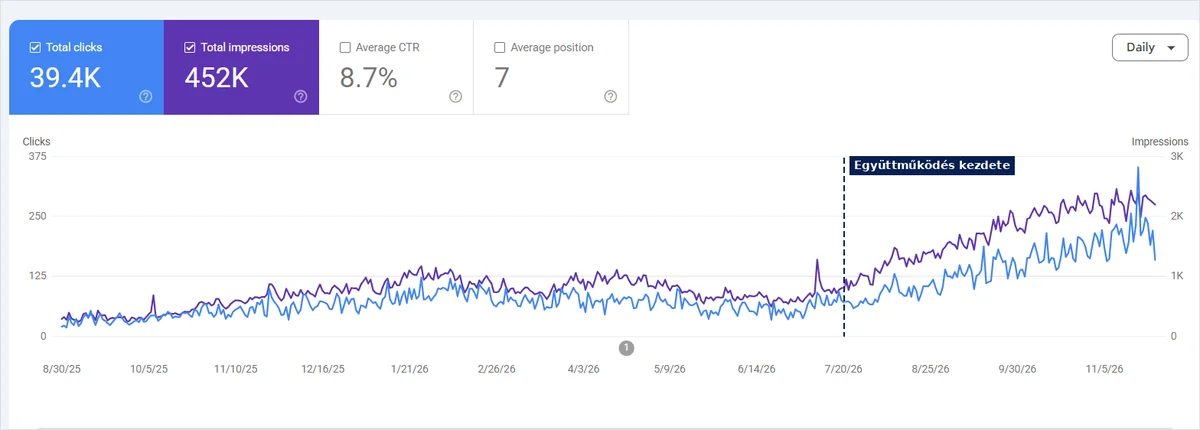
We show the results with Google Search Console data. The dashed line marks the start of our work, in July 2026. Before that, daily clicks mostly stayed below 100 and impressions hovered around 1,000. By November, clicks were typically between 150 and 250 a day and impressions above 2,000 a day, so both grew roughly two to three times. These are approximate values read from the chart.
Over the full 16-month period the site collected 39,400 clicks and 452,000 impressions in total, with an average CTR of 8.7% and an average position of 7.
Impressions on Google's generative AI surfaces
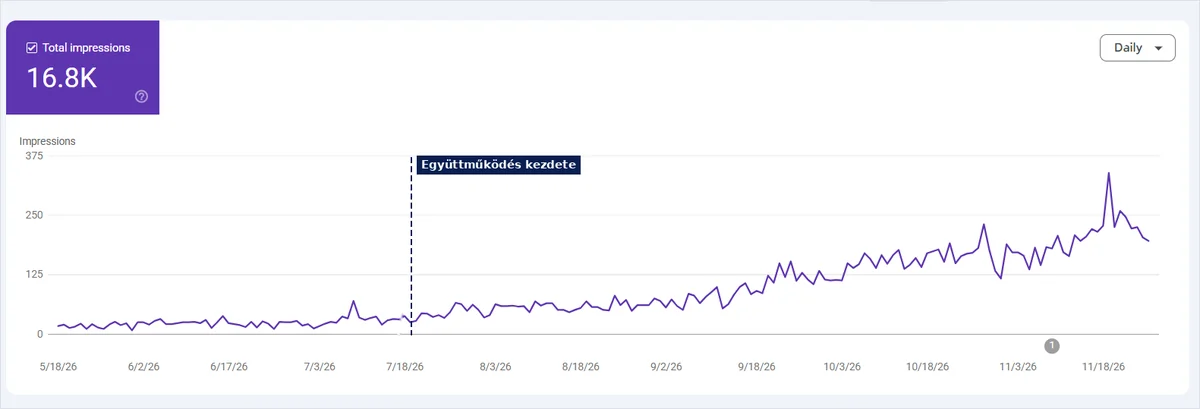
We also looked separately at impressions on Google's generative AI surfaces. Since 18 May 2026 the site has collected 16,800 of them. Before we started, this was around 20 a day; in November it is between 150 and 230 a day, with a peak day above 330, which is roughly a tenfold increase. We explain how these results are produced in our knowledge base article on AI Overview.
Fewer indexed pages, more clicks
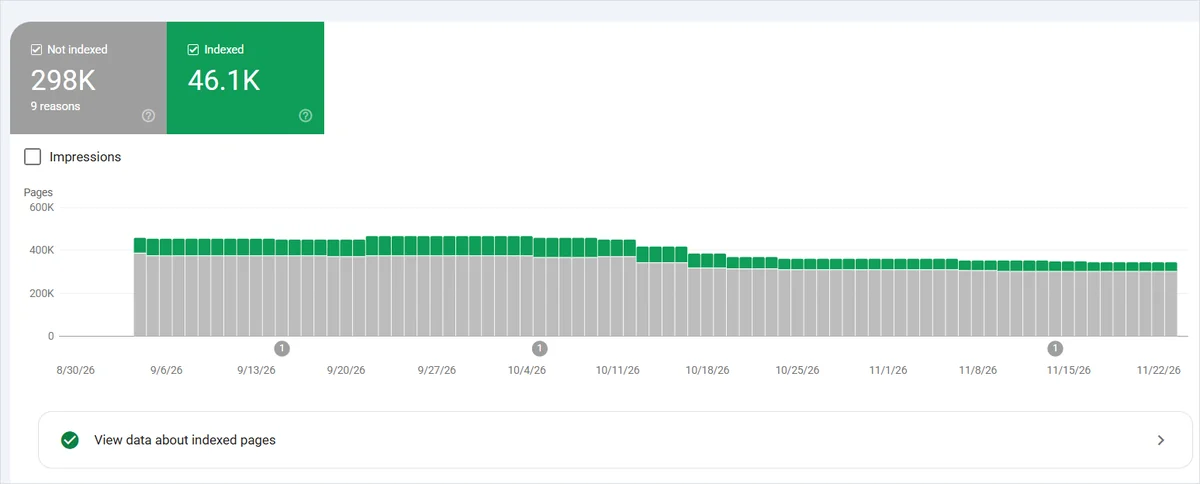
Meanwhile the number of indexed pages fell: in early September, where the chart starts, it was around 70,000; now it is 46,100, with 298,000 URLs not indexed. This is a good sign. Google gradually drops pages that give searchers and visitors no new information. In online stores these are, for example, near-identical URLs created by filters and sorting options. That leaves more of the crawl budget for real product and category pages, and clicks did not fall in the meantime: they grew.
You can read about another online store project of ours in the online store SEO and link building case study.
Would you like similar results for your own website?
Ask for a free consultation: we will review your situation and put together a tailored plan based on your goals.