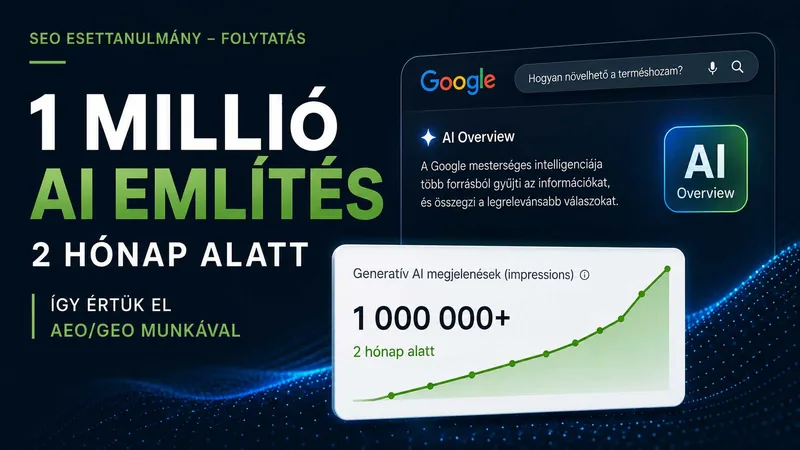

In short: AI Overview is an AI-generated summary at the top of Google's results page that compiles an answer from several websites and links to them as sources. Where it appears, fewer people click through – so ranking alone is no longer enough: you need to be a source. That takes structurally clean, quotable, up-to-date and credible content, and crawlers being able to reach the site without obstacles.
What is AI Overview, and how does it work?
AI Overview is Google's AI-powered search feature. It analyses the content of several websites and then creates a summary in response to the user's query, directly at the top of the results list – even above the first organic result. It usually consists of a text answer block, source links and related questions.
The system is built on large language models (LLMs), machine learning and traditional search algorithms, in roughly four steps:
- Interpreting intent: it looks not only at the keywords but also at the context of the question and the underlying information need – which is why it works well for longer, conversational searches.
- Selecting sources: it looks for relevant, credible, well-structured pages.
- Compiling the answer: it generates a concise summary from the selected sources.
- Displaying sources: it links to the pages the information comes from.
This last step is what matters for a business: if your site is the source, your brand name appears even when the user does not click. That is exactly the goal of our agency work today: to get the client's name and website into as many AI answers as possible, ideally with a link.
For which searches does it appear?
Mostly for informational, comparison and how-to searches:
| Search type | Example | AI Overview |
|---|---|---|
| Informational | "What is AI Overview?" | Frequent |
| Comparison | "SEO vs GEO" | Frequent |
| How-to | "How does PPC work?" | Frequent |
| Advice | "Which CRM should I choose?" | Frequent |
| Transactional | "air conditioner price with installation" | Less frequent |
| Local | "car mechanic Debrecen" | Less frequent |
| Brand name (navigational) | "ad-ops contact" | Rare |
The appearance rate is growing fast. According to industry measurements, AI Overview appeared for 7.64% of Google searches in February 2025, for 13.14% by March, and in the first quarter of 2026, according to a study of 21.9 million searches, for roughly a quarter of US searches. The methodologies and markets of these measurements differ, so treat the rates as a direction rather than exact values.
Why does it reduce organic traffic?
Where AI Overview appears, the user often gets the answer on Google's page and does not click through. This is zero-click search. Industry measurements all point in the same direction:
| Metric | Change | Source |
|---|---|---|
| Organic CTR when AI Overview appears | –61% on average | Seer Interactive, 2025 |
| CTR of position 1 alongside AI Overview | between –34.5% and –59% | Ahrefs, SISTRIX |
| Organic search traffic by 2028 (forecast) | up to –50% | Gartner |
How it shows in Search Console: impressions rise or stagnate, while clicks and CTR fall, with unchanged rankings. This is called the "Great Decoupling". It is not a technical error and not necessarily a quality problem, but a sign that the search interface is changing.
Informational, definition and how-to content is hit hardest: media sites, health and technology explainers, recipes, basic financial concepts. Less affected are transactional and local searches, complex questions that require comparison, and content based on first-hand experience, such as case studies.
What content does it like to cite?
AI Overview does not choose sources at random. It cites content from which it can extract a clean, self-contained answer:
- Definitions and explanations – especially if the key point is at the top of the page.
- List- and step-based content – numbered steps, short bullet lists.
- Comparisons in tables – for "X vs Y" and "which should I choose?" type questions.
- Own data, original measurements – things only you know: client cases, tests, internal statistics.
- Fresh, regularly maintained content – with current data and a visible update date.
- Rich content – relevant images, charts or video alongside text, with descriptive alt text.
- Passages quotable on their own – one-to-three-sentence "answer islands" that give a complete answer even without context.
Some industry measurements that support this (third-party analyses, not Google data):
- list- and structure-based content receives roughly 2.5 times more AI citations than running text;
- 44.2% of citations come from the first 30% of the content;
- 53.4% of cited pages are shorter than 1,000 words;
- content presenting its own data achieves 30–40% greater visibility in AI systems;
- 85% of AI Overview sources were created or updated in the past two years.
How do you get into AI Overview? – 7 steps
1. Question-based subheadings with a direct answer
Phrase your H2s as questions, and make the first one or two sentences below them give a direct answer before you expand on the topic.
2. A quotable sentence in the first 100–200 words
Have a short block at the top of the page that answers the main question on its own – with precise data or a definition.
3. Strong E-E-A-T signals
Show the author by name and professional background, the publication and update dates, cite sources, and demonstrate first-hand experience (first-person examples, measured results).
4. Structured formats
Present steps in numbered lists, and data and comparisons in tables. Avoid long, unbroken blocks of text.
5. Schema markup
Article (with author, date and publisher), FAQPage for question-and-answer sections, HowTo for step sequences, Person for the author. It will not get you in on its own, but together with good content it helps.
6. Own data and multimedia
Include your own measurements, client cases, images or video. What you measured and published yourself, AI will cite from you, not from whoever copied it.
7. Regular updates
Review important articles at least once a year: update the figures, replace outdated examples, and mark the update date.
What can push you out? – 7 common mistakes
Many pages rank well yet receive no AI citations (according to one industry analysis, 43% of relevant pages on a topic receive none). The cause is almost always one of these:
- Technical obstacles. Noindex, robots.txt blocking, content rendered with JavaScript and therefore not visible, slow or faulty (5xx) responses, wrong canonical. Check your robots.txt and the Indexing report in Search Console.
- No extractable answer. If the page is one long block of text, AI cannot find the specific answer in it. Every H2 needs a short, self-contained "answer island" (roughly 40–80 words).
- Weak credibility signals. No author, no date, no first-hand experience and no sources.
- Outdated content. Old statistics, expired examples, no update date.
- Missing or faulty schema. For example Article schema without author and date, or no FAQPage for the question-and-answer section.
- Duplicate or thin content. Strength is split between several very similar URLs, and none of them gets in. Solution: consolidation, correct canonical, 301 from the weaker URL.
- Weak brand authority. AI systems rely heavily on the brand as an entity. Mentions of the company name on other credible sites (PR, professional collaborations, interviews) count just as much as links.
You can only opt out together with snippets. AI Overview is part of Google Search: it is controlled by the nosnippet, data-nosnippet and max-snippet directives, which also affect traditional search snippets. According to Google, blocking Google-Extended in robots.txt does not affect search appearance, and therefore does not affect AI Overview either. Other companies' AI crawlers (e.g. GPTBot, ClaudeBot) have to be handled separately.
What to do if traffic is falling – order of priority
Do not try to fix everything at once. The order we follow in our projects:
- Technical check: robots.txt, noindex, indexing errors, rendering.
- Update the most important pages: fresh data, update date.
- Answer islands: a short, direct answer under every H2.
- Schema: at least Article and FAQPage.
- Author credibility: name, professional profile, first-hand experience.
- Brand building: PR, professional appearances, collaborations.
Alongside this, it is worth adjusting your content strategy: more attention to transactional and local searches, deeper content built on your own data (case studies), and a stronger email and social presence, because AI Overview only affects Google organic traffic.
How to measure it
Search Console does not show AI Overview impressions separately: they are included in the web search performance report together with the other results. So measurement rests on three pillars:
- Search Console trend: impressions and clicks by keyword – if impressions rise while CTR falls, AI Overview may be the cause.
- Manual or tool-based checks: whether AI Overview appears for your most important questions, and whether you are in it as a source.
- Other AI interfaces: ChatGPT, Gemini and Perplexity answers are worth monitoring separately – this is what the AI visibility audit measures.
The effect of improvements is not immediate: in our experience it typically takes a few weeks to show, provided the page already ranks well for the query. If you do not know where you stand, an SEO audit will reveal the biggest losses.
Want to be a source in AI answers?
In our free AI visibility audit we show you whether you appear in Google AI Overview, ChatGPT and Gemini answers, and who they recommend instead of you.