
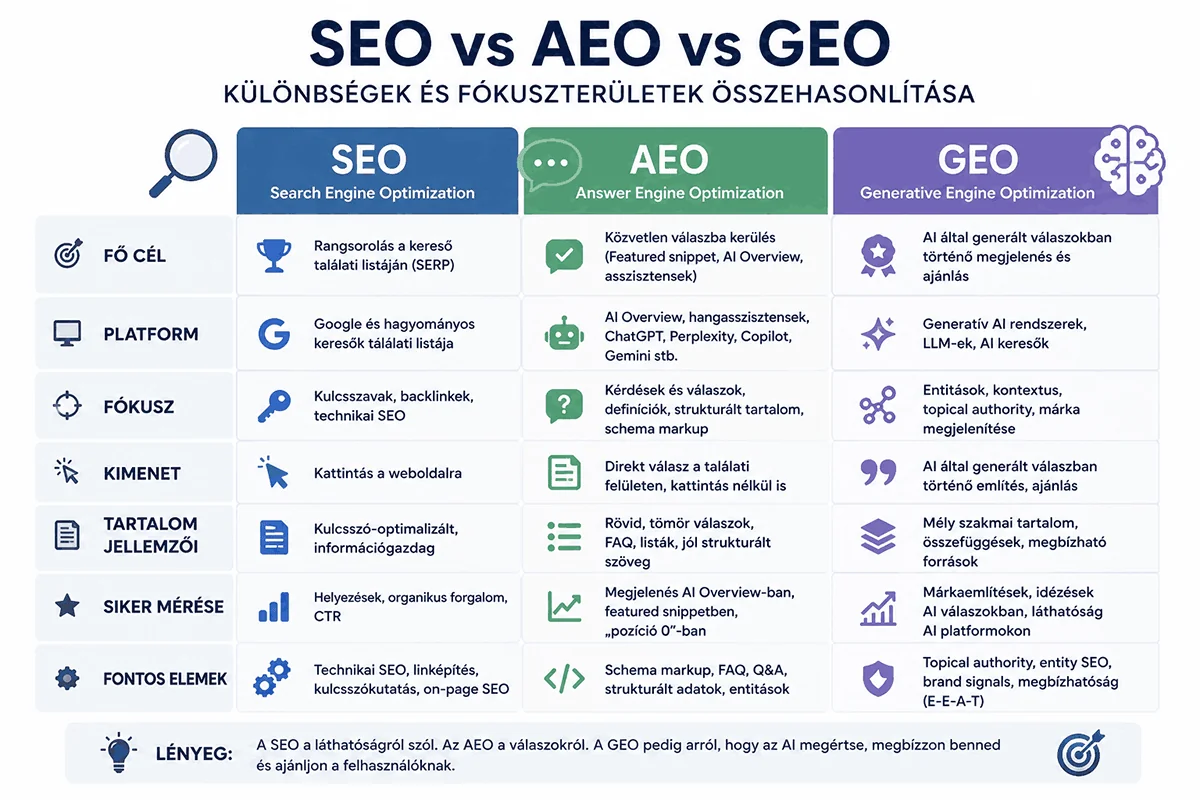
In short: SEO is about ranking, AEO is about answer engines giving your content as the answer, and GEO is about generative AI understanding your brand and recommending you. The three are not alternatives to one another but build on each other: without a strong SEO foundation, AI search engines will not cite you either. In practice this means direct answers, structured content, clear entities and a credible brand.
What is SEO?
SEO (Search Engine Optimization) is classic search engine optimisation: the goal is better positions in Google's results, more organic traffic and rankings for relevant keywords. Its main areas are technical SEO, content optimisation, keyword research, link building, user experience and internal linking. We measure its success in rankings, organic traffic and click-through rate (CTR).
What is AEO?
AEO (Answer Engine Optimization) is optimisation for answer engines – Google AI Overview, ChatGPT, Gemini, Perplexity, Copilot. Here the goal is not necessarily for the user to click through, but for the system to use your content as the answer. For that, the content has to be clear, structured, easy to quote and quick to process: definitions, short answers, FAQ blocks, well-organised subheadings and schema markup.
The difference in an example: with an SEO mindset you would write the title "Best SEO tips for online stores", with an AEO mindset "What is the most important SEO factor for online stores?". From the latter, AI can extract a specific answer much more easily.
What is GEO?
GEO (Generative Engine Optimization) is the next level: it is not just about individual answer blocks, but about how AI models understand your brand, how they treat your content as a source, and how often and in what context they cite or recommend you. Its focus is on entity SEO, topical authority, brand mentions, consistent expert content and trustworthiness (E-E-A-T).
SEO, AEO and GEO compared
| Aspect | SEO | AEO | GEO |
|---|---|---|---|
| Platform | Google search results | AI Overview, assistants | Generative AI systems |
| Focus | Keyword | Question and answer | Context and entity |
| Output | Click | Direct answer | AI mention, recommendation |
| Content | Keyword-optimised | Structured | Knowledge-based |
| Key element | Links | Schema | Brand authority |
| Measuring success | Rankings, traffic, CTR | Appearance in answer blocks | Brand mentions, citations in AI answers |
What does zero-click search mean?
Zero-click search means that the user gets the answer on the results page itself and does not click through to any website. It used to occur mainly with simple questions (weather, calculations, definitions); because of AI Overview it is now common for more complex, informational searches too. Three things drive it: AI Overview, the featured snippet and the Knowledge Panel.
According to industry estimates, a significant share of Google searches – nearly two thirds by some measurements – end without a click, and the rate is even higher for searches that trigger AI Overview. For transactional searches (purchases, quote requests), however, it is much lower, because there the user has to click through to achieve their goal.
This is not necessarily a disaster:
- The remaining traffic has stronger intent: those who still click through after the AI answer typically want more than a quick answer.
- The brand is still visible: if you are cited as a source, your name appears even without a click.
- In-depth content is less affected: case studies, opinion and experience-based articles, comparisons, local and transactional searches.
What is entity SEO, and why is it the foundation of GEO?
Entity SEO means building your website not around keywords but around entities – clearly identifiable brands, people, products, places and concepts – so that Google and AI search engines know exactly who or what the page is about and how it connects to other known entities.
Traditional SEO was based on matching words. Entity-based search looks for meaning and relationships: Google keeps track of entities in its own knowledge base, the Knowledge Graph (according to Google's 2020 statement, 500 billion facts about 5 billion entities). Google uses natural language processing to identify the entities on your page and connects them with each other: your company, your services, your field of expertise. This network is strong if you consistently use the same names and relationships on your site, and external, trustworthy sources confirm them.
In practice:
- Define your main entities: brand, services, key people, industry concepts.
- Use schema.org data: Organization and Person types with
name,url,logoandsameAsfields. - Connect yourself to external profiles (
sameAs): LinkedIn, Google Business Profile, Wikidata, industry databases. - Build a logical structure: topic clusters, internal links, consistent terminology.
- Be consistent everywhere: the company name, address and description should match on your website, your Google Business Profile and your social media pages.
The most common mistake is precisely the last one: a different name appears on the website than on the Google Business Profile or social media, which confuses entity recognition.
How do AI search engines "see" a website?
- Google AI Overview: it is built on Google's own search index, so those who rank well on Google are more likely to get in.
- ChatGPT: its search feature relies partly on the Bing index and also uses its own crawler (OAI-SearchBot). So it is worth setting up Bing Webmaster Tools and submitting your sitemap, and not blocking OAI-SearchBot in robots.txt.
- Perplexity: it works with its own crawler and, for time-sensitive topics, favours fresh, well-structured content.
The common denominator: they all prefer to cite well-structured, credible content that gives a clear answer.
How to optimise for AI search – 5 steps
1. Content structure: put the answer first
AI systems cite most from the beginning of articles (according to one analysis, 44% of ChatGPT citations come from the first 30% of the page). So do not start with an introduction: the first 40–80 words should give a concise answer to the question in the title. Phrase subheadings as questions, keep paragraphs short (3–4 lines), and present steps and comparisons in lists or tables.
2. Technical fundamentals
- Schema markup (JSON-LD): Article, FAQPage, HowTo, Organization, BreadcrumbList.
- Bing Webmaster Tools set up and sitemap submitted.
- Allow AI crawlers in robots.txt (if you want to be cited).
- Author, publication and update dates on every article.
- llms.txt: a cheap addition, but not the priority.
3. Entity-based content
Name tools, companies and concepts precisely ("Google Search Console" instead of "the platform"). Define your own company and services clearly, cite credible sources, and write firm, quotable sentences.
4. Topical authority
One article is not enough. Choose a main topic and build interlinked content around it (for example: what GEO is, what AEO is, AI Overview, llms.txt, measuring AI traffic in GA4). This signals to AI that the site covers the topic in depth.
5. E-E-A-T: experience and credibility
Include your own measurements, case studies and test results in your content – AI can only cite these from you. Write with a firm professional opinion, cite sources, and update your well-performing articles regularly.
Tips by platform
| Platform | What to focus on |
|---|---|
| Google AI Overview | Good Google rankings, strong E-E-A-T, a short direct answer at the top, FAQ schema. |
| ChatGPT | Bing Webmaster Tools, OAI-SearchBot not blocked, definition and how-to content, firm statements. |
| Perplexity | Question-style H2/H3 subheadings, fresh content, external source citations. |
Traditional SEO vs AI search optimisation
| Aspect | Traditional SEO | AI search optimisation |
|---|---|---|
| Goal | Ranking in search results | Being cited in AI answers |
| Metric | Position, clicks | AI appearances, brand mentions |
| Content focus | Keywords | Entities, question and answer |
| Structure | More flexible | Highly structured, answer first |
| Technical basis | Google Search Console | + Bing Webmaster Tools |
| Updates | Moderate | Regular (every 3–6 months) |
| Schema | Recommended | Strongly recommended |
The two are not alternatives: they have to be done in parallel, and strong traditional SEO is the foundation of AI search optimisation.
Checklist
Content
- A direct answer in the first 100 words
- Question-style H2/H3 subheadings
- Short paragraphs, lists and tables
- Own data, experience, concrete examples
- Precisely named entities (companies, tools, platforms)
- Internal links to related content
Technical
- Article, FAQPage and (where relevant) HowTo schema
- Organization and Person schema with
sameAsreferences - Author and update date displayed
- Bing Webmaster Tools set up, sitemap submitted
- AI crawlers not accidentally blocked in robots.txt
Long term
- Topic cluster plan (10+ related pieces of content)
- Update important content every 3–6 months
- Monitor AI appearances: regularly ask ChatGPT and Gemini about your own topics
- Consistent company details on your website, Google Business Profile and social media pages
Want AI to recommend you?
In our free AI visibility audit we show you whether you appear in ChatGPT, Gemini and Google AI Overview answers, who they recommend instead of you, and what is worth fixing first.