Introduction
This case study shows how we helped a Budapest car service significantly increase its online visibility and number of customers through search engine optimisation (SEO).
Our client’s goal was to get into the top results on Google for the keyword “car service Budapest”, and in turn win more inbound calls and bookings. Just as a car needs regular maintenance to stay in top shape, a website needs a “digital service” – SEO – to get to the front of the pack on the online racetrack.
In short: within a few months we took the service’s website into the Top 3 of Google’s organic results for the most important search term, while also bringing the site onto the first page for many other car repair services. As a result, organic traffic rose sharply and the number of phone calls multiplied – in other words, enquiries from search turned into real customers for the garage.
Below we walk you step by step through the strategy we used and the SEO tools we deployed – from technical audits through content development to link building – and the results we achieved. With this detailed case study we want to show other car services and workshops how a professional SEO team can boost their online presence and ultimately bring more customers and bookings into their workshop.
About the client
Our client is a car service in Budapest offering comprehensive car repair and maintenance services in the capital. For a car service like this, a steady flow of new customers is essential day to day – whether for oil changes, car diagnostics, brake repairs, bodywork repairs, car painting or even fleet management services.
The workshop handles both mechanical and bodywork jobs, and also fleet management, meaning that alongside private customers it maintains company car fleets. The garage is equipped with modern tools and employs several experienced mechanics, so its range of services is broad – and that is what they wanted to make visible online too.
Market situation
There are a huge number of car services and repair workshops in Budapest, so competition is fierce. Most people today look for a solution online – most often in Google search – when, for example, their car breaks down or the next service is due. In those moments they typically search for terms like “car service [district/neighbourhood]”, “reliable mechanic Budapest”, or, focusing on the specific problem, “oil change Budapest”.
Before the SEO project started, our client’s website was almost entirely absent from these relevant searches: it appeared only on the second or third page of Google’s results, or even further back – if at all. As a result, the number of new customers coming from the website was minimal, because if you are not on the first page, you are practically invisible to potential customers.
The challenge: goals and expectations
The client came to us with a very specific goal: to get its website into Google’s top three results for the keyword “car service Budapest”. This was an ambitious but realistic goal, given that businesses in the Top 3 positions get the most clicks in search: most users click on one of the first few results and rarely go on to the second page.
Beyond that, the client wanted to increase its online presence in general and get as many of its services as possible into the top of the relevant searches. One person might search for an oil change, another for brake servicing or bodywork repair – the point is that whatever car repair need arises, the company’s website should be there in the results.
The aim was not just more clicks, but to turn those visitors into actual customers. Better Google rankings had to show up as more phone calls, enquiries and bookings. That is the ultimate yardstick: a good ranking is worthless if it brings no new work to the workshop.
It is also important to stress that we had to achieve all this cost-effectively, within a fixed monthly budget – a so-called 5-hour-a-month SEO package. That means we could spend roughly one working day a month developing and optimising the website. So the challenge was clear: achieve impressive results on Google with limited resources, but with smart prioritisation and expert know-how.
Why does SEO matter for a car service?
When our car breaks down or the mandatory service is coming up, most of us grab our phone and search for the nearest or best-rated garage. Whoever ranks higher in Google search – especially in the map results for local searches and in the organic list – is far more likely to get the call than someone trailing somewhere at the back of the list. A well-executed SEO strategy helps car services in several ways:
- Greater visibility in local searches: through local SEO, the garage can appear in Google Maps results and in “near me” type searches. The higher you are in these, the more customers walk through your door.
- Building credibility and trust: people tend to trust the results Google recommends in prominent positions. A garage that appears on the first page can inspire trust by that fact alone.
- Lower advertising costs: paid ads (e.g. Google Ads) provide instant visibility, but they can be costly in the long run. With traffic from organic results, however, you do not pay per click: once you achieve good rankings, they provide continuous, “passive” customer acquisition.
- Part of a comprehensive, 360° marketing approach: a car service’s marketing includes, alongside SEO, social media activity, collecting customer reviews, email marketing and paid advertising. Experience shows that SEO deserves particular attention, because it gives a solid foundation to your online presence.
Put simply: the higher you are on Google, the more cars will pull into your garage’s yard. That is exactly what our client wanted to achieve.
SEO audit and first steps
Every successful SEO project is built on a thorough SEO audit, so naturally we started with one for this car service too. An SEO audit is a complete review of a website from a search engine optimisation perspective: using specialist software and many years of professional experience, we crawled the website and mapped all the technical errors, gaps and development opportunities that could stand in the way of good Google rankings. It is like putting a car through its roadworthiness test.
What did the audit reveal?
- There were several links on the site leading to 404 errors – links pointing to non-existent pages, sending visitors (or Google’s crawler) into a dead end.
- Important pages had incomplete or inadequate meta titles and meta descriptions. These play a key role in helping Google understand a page’s content and in encouraging clicks in the results list.
- There were also some smaller speed optimisation opportunities, such as image compression and a better mobile experience.
- We also mapped the site’s structure and found opportunities to improve internal linking.
We recorded the audit findings in a detailed report and an action list (roadmap) in order of importance: in the first round we brought forward the most urgent tasks promising quick improvement (“quick wins”). As the monthly time budget was limited to 5 working hours, choosing the right priorities was especially important.
Fixing technical and content issues
After the audit we immediately set about fixing the issues we had found. This phase was like a major service for the website: small but important interventions that, taken together, greatly improve the site’s health and Google-friendliness.
Fixing 404 errors
We weeded out every link pointing to a 404 error: broken links were either removed or – where it made sense – replaced with the correct, working page. This way neither visitors nor search engine crawlers run into dead ends on the site.
Optimising metadata
We wrote or fine-tuned the meta title and meta description for every important subpage. We made sure that every page got a unique, descriptive title containing that page’s main keyword.
Speed and mobile-friendliness improvements
We optimised the larger image files through compression and, where necessary, resizing, which cut a few seconds off the loading time. We also introduced a caching solution and checked the mobile view.
Improving the internal link structure
On the homepage we created a section listing the main services, with a direct link from there to each service’s detailed description. With these interventions we refreshed the website’s foundations and gave a stable starting point for further SEO work.
Keyword research and content optimisation
Once we had removed the website’s technical obstacles, we shifted the focus to content development. The client’s website previously had rather brief service descriptions, and that needed to change.
Keyword research
As a first step, we carried out keyword research to identify exactly which search terms people use in connection with car servicing. “Car service Budapest” was the main target keyword, but many long-tail (more complex, multi-word) keywords were also relevant:
- Specific services: “oil change Budapest”, “brake pad replacement Budapest”, “car air conditioning recharge Budapest”, “car diagnostics Budapest”, “bodywork repair Budapest”, “car painting Budapest”.
- General car repair searches: “reliable mechanic Budapest”, “car service opening hours Saturday”, “car service roadworthiness test”.
- Local searches: “car service District XIII”, “mechanic Újpest”, etc.
During the keyword research we also assessed search volumes, which helped us set priorities for content development.
Writing the service pages
The website had separate subpages presenting the main services, but their content was short and not very informative. For every service page we wrote a comprehensive, keyword-optimised description that naturally includes the target phrases but avoids keyword stuffing – the text should be readable and useful.
Structured, well-organised content
An important consideration was that the content should be well structured and easy to scan: we used subheadings, bullet lists and relevant images on every page, and wrote alt text for the images too.
Software-assisted post-optimisation
After the copy was written, we fine-tuned the content with AI-based SEO content analysis software: we added missing terms and broadened the topical coverage.
Competitor analysis and homepage optimisation
We also paid particular attention to competitor analysis: we looked at who appears on Google for the targeted keywords, how, and with what strategy they achieved their rankings. We carried out an especially thorough analysis for the keyword “car service Budapest”.
What did we see at the competitors?
Among the Top 10 results for “car service Budapest”, we saw that almost every competitor appears with its own homepage for this search. On our client’s website, however, a subpage originally targeted this keyword. On that basis, a strategic change of direction was needed:
- Rethinking the homepage’s role: we made the homepage the “flagship” for the car service Budapest topic.
- Integrating the subpage’s content: we brought the relevant content into the homepage and eliminated keyword cannibalisation.
Redesigning the homepage
- New homepage copy presenting the garage’s advantages and services and containing the relevant keyword.
- A service summary section with icons, short descriptions and internal links to the detailed subpages.
- Customer reviews and CTAs: booking, a call button, a prominent phone number.
- Bringing in the former subpage’s content so that useful information would not be lost.
Content marketing: blog posts and internal linking
Once the website’s main structural and content elements were in order, we created blog posts that bring additional visitors from Google and support the service pages’ rankings through internal links. A few example topics:
- “How do you know it’s time to change your car’s oil?”
- “5 tips to avoid premature brake wear”
- “Why isn’t the air conditioning cooling properly in summer?”
- “Independent mechanic vs. dealer service: when to go where?”
In the blog posts we consistently used internal linking: we turned related keywords into links leading to the appropriate service page. We scheduled new content monthly, because Google likes a website that is updated regularly – but quality came first: we preferred to publish fewer, well-written, longer articles.
Link building on external sites (PR articles)
The other key pillar of SEO is link building – acquiring links (backlinks) from external websites. For Google’s algorithm these links are like references: if many high-quality websites link to us, it is a strong signal of credibility.
- PR articles: we placed articles on relevant automotive and local/national sites, each with a link back to the client’s website using natural anchor text – not only to the homepage but to the service pages as well.
- A quality link profile: we only acquired links on topically relevant and credible sites, and paid attention to keeping the link profile natural.
- Other mentions: we encouraged collecting Google reviews and looked for social media opportunities that naturally increase brand awareness.
Results and business impact
The results of the work exceeded expectations. For the main target keyword (“car service Budapest”), the website was practically invisible at the start of the project, then gradually climbed into the Top 3, and finally reached No. 2.
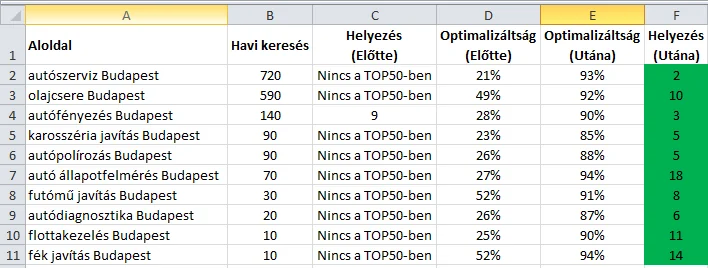
It was not just this one keyword that improved: for most of the important service keywords the site also reached the first page or close to it, meaning that the online visibility of the entire range of services grew significantly.
Organic traffic growth
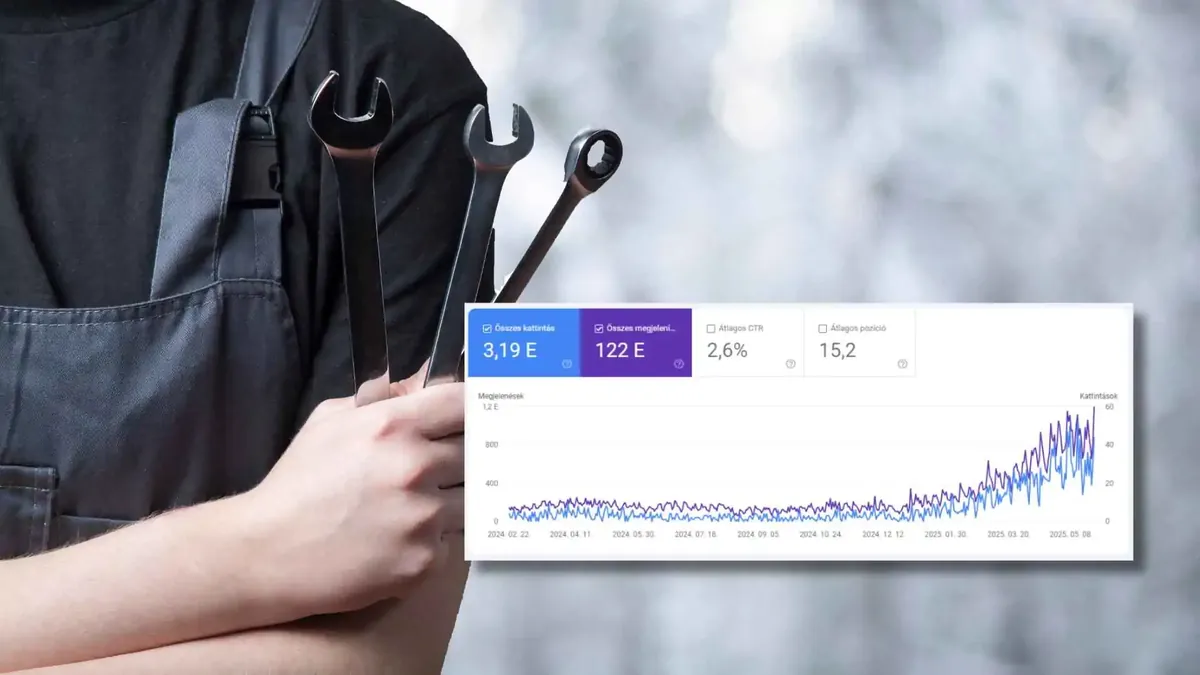
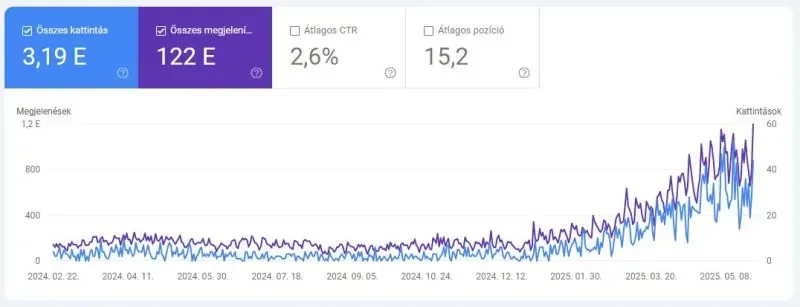
Better rankings brought an increase in organic visitors as well. According to Search Console data, organic impressions and clicks rose steeply over the course of the project.
Conversions and business results
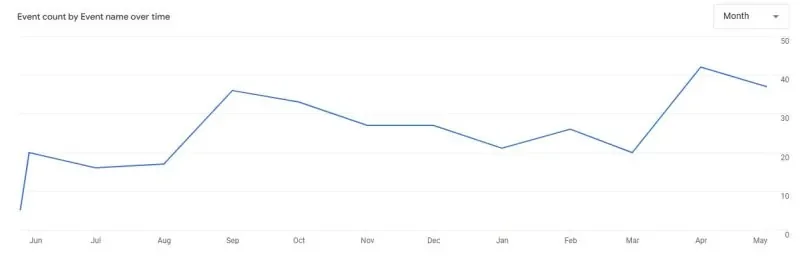
Increased traffic is only really worth something if it turns into actual customers. Conversion tracking (form submissions, “Call” clicks) showed a significant rise, with the number of phone calls growing especially strongly.
Return on investment
The 5-hour-a-month SEO work paid for itself cost-effectively: the improved Google presence continuously brought in new enquiries, which produced tangible business results. SEO is not a one-off campaign effect but a stable customer acquisition channel that can be built up over the long term.
Positive side effects
The improved organic presence also benefited the brand: more branded searches, more reviews, stronger trust. The blog posts also produced more shareable content for social media communication.
Conclusion and next steps
This case study is a good example of how a well-thought-out SEO strategy can deliver impressive results for a local service provider even with limited resources. The key to success was that we covered every important area:
- Technical foundations: audit, fixes.
- High-quality, relevant content: service pages, blog.
- Following the competitors’ logic: strategic optimisation of the homepage.
- External reinforcement: link building, PR articles.
The most important lesson is that SEO brings lasting success as the result of persistent, continuous work. The next steps: new content, monitoring rankings, strengthening the local presence, and further optimising the conversion elements (CTAs, booking, tracking).
Would you like similar results for your own car service?
Ask for a free consultation: we will analyse your website’s current position and put together a tailored plan so that your workshop is on the first page of Google too – and you get more customers from search.